Labs · Future
What could AI do next? Evidence before hype.
Explore AI-assisted science, energy optimization and supervised tools through published research—not promises about inevitable breakthroughs.
The takeaway
The useful future of AI depends on measured performance, real-world evidence and accountable people—not a countdown to a guaranteed breakthrough.
Scientific tools, checked against reality
The 2024 AlphaFold 3 paper describes predicting structures of biomolecular complexes involving proteins, nucleic acids and small molecules, among other components. This supports a discussion of AI-assisted molecular research—not a claim that AI has solved drug discovery.
The paper also records limitations, including incorrect chirality and restricted conformation coverage. Predictions can help researchers investigate possibilities, but they are not automatically correct experimental findings. Future progress could come from combining better models with appropriate testing and scientific expertise.
More useful energy systems—not guaranteed savings
The International Energy Agency documents existing AI applications for energy-system efficiency, reliability and innovation. AI could help operators forecast demand or improve operations where suitable data, infrastructure and expertise exist.
The IEA's Widespread Adoption Case is a scenario that assumes many adoption barriers are overcome, not an assured outcome. AI also consumes electricity. A credible efficiency project measures the whole change, including computing costs and operational results, instead of assuming that using AI automatically reduces energy use.
Capability is only part of the future
Useful assistants need evaluation, privacy safeguards, access boundaries and human oversight. NIST's generative-AI profile discusses risks including confabulation, harmful bias and information integrity. A more capable model is not, by itself, proof of a trustworthy system.
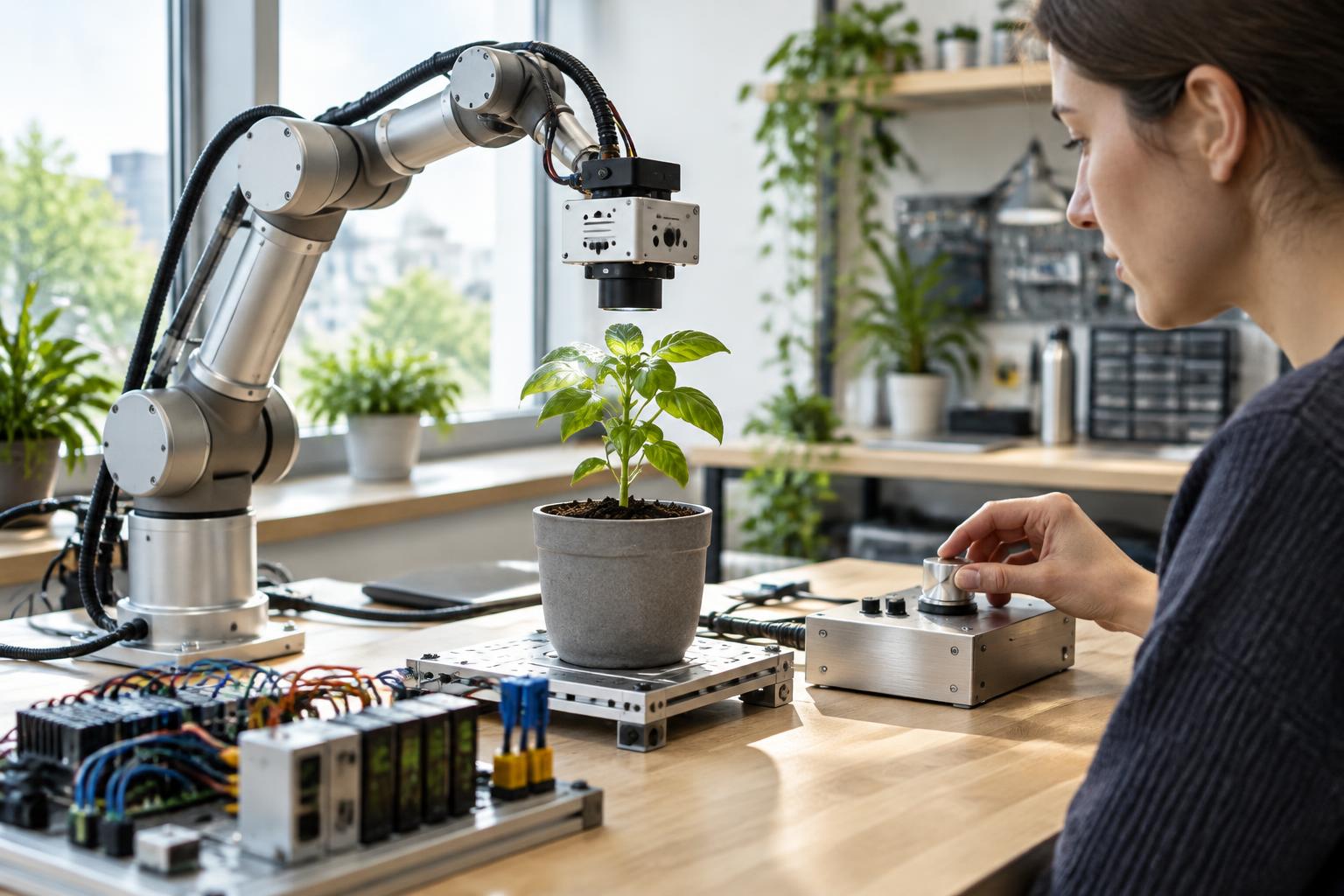
For SkyHub Labs, the practical question is whether an experiment helps someone complete a real task and whether its limits can be explained. Wonward remains in beta; our playground tools are learning prototypes. The robotic scene illustrates a possible direction, not a SkyHub product announcement or a promise of delivery.
Sources & further reading
- Nature: Accurate structure prediction of biomolecular interactions with AlphaFold 3 (2024)
- IEA: AI for energy optimisation and innovation
- NIST: Generative AI risk management profile